





“Christ is the heart of the world, and the paschal mystery of his death and resurrection is the centre of history, which, because of him, is a history of salvation” (31).
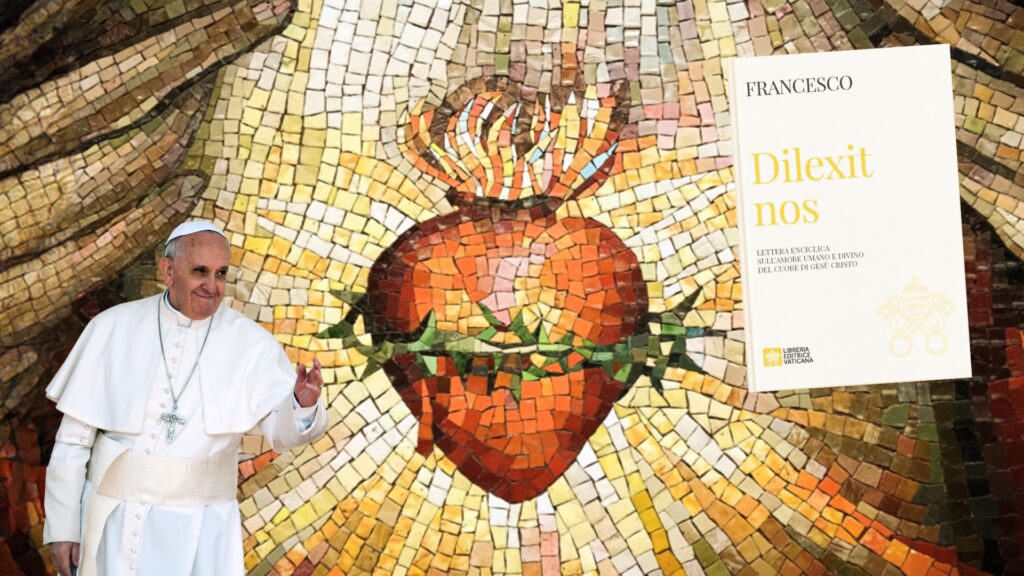
At the core of Pope Francis’s new encyclical Dilexit Nos: He Loved Us- On the Human and Divine Love of the Heart of Jesus Christ is the mystery of the Sacred Heart of Jesus, which reveals that “every human being is created above all else for love” (21). This symbol synthesizes the entire Gospel (83), expressing the source from which salvation flowed for all humanity (52).
The heart is so powerful a symbol because the heart is where our deepest self-understanding resides. One’s heart shapes one’s spiritual identity and enables communion with others (14). This encounter of communion is part of a cosmic journey of salvation, as all creatures “are moving forward with us towards God, where the risen Christ embraces and illumines all things” (31, quoting LS 83). Indeed, each one’s name is written on the heart of Christ, who knows and loves each of us deeply, personally, as she or he truly is (115).
Yet today, when our world struggles with “wars, socio-economic disparities and uses of technology that threaten our humanity” (31), we need more than ever to recall the “ever-present love of the heart of Christ” (84). Too many are lost in the ”frenetic pace of today’s world and an obsession with consumption, cell phones and social media,” swept under a “powerful wave of secularization” (87).
Amid such troubles Jesus invites us to find fresh strength and peace: “Come to me, all who are weary and are carrying heavy burdens, and I will give you rest” (Mt 11:28). Jesus says to us today as to his disciples, “Abide in me” (Jn 15:4): that is, rest within his heart (43).
Pope Francis invites us to an encounter with Christ’s heart, where we learn to build up in this world God’s kingdom of love and justice. With an every-hopeful faith, Pope Francis writes that we “are capable of working this social miracle!”(28). As disciples, our “best response to the love of Christ’s heart is to love our brothers and sisters” (167).
Pope Francis warns of any pious spirituality in which reverence for the Sacred Heart of Jesus becomes “a private religious experience while ignoring its implications for the society in which we live” (205). Instead, he calls us to “be honest and accept the word of God in its fullness”, which leads to the “missionary dimension of our love for the heart of Christ” (205).
Discipleship thus entails what Saint John Paul II called the “social dimension of devotion to the heart of Christ”. This social dimension, expressed as “civic and political love” in Laudato Si’, renews the Christian mission of co-creation. “Through the witness of Christians, love will be poured into human hearts, to build up the body of Christ which is the Church, and to build a society of justice, peace and fraternity” (206).
Amidst the challenges we face, Pope Francis shares a vision of Christian joy in the love of God poured out in Jesus, which we can bring to others and to the ministry of healing our relationships and our earth. “Keep experiencing the joy born of our efforts to share the love of Christ with others […] For it is by drinking of that same love that we become capable of forging bonds of fraternity, of recognizing the dignity of each human being, and of working together to care for our common home” (216-7).
Love it