





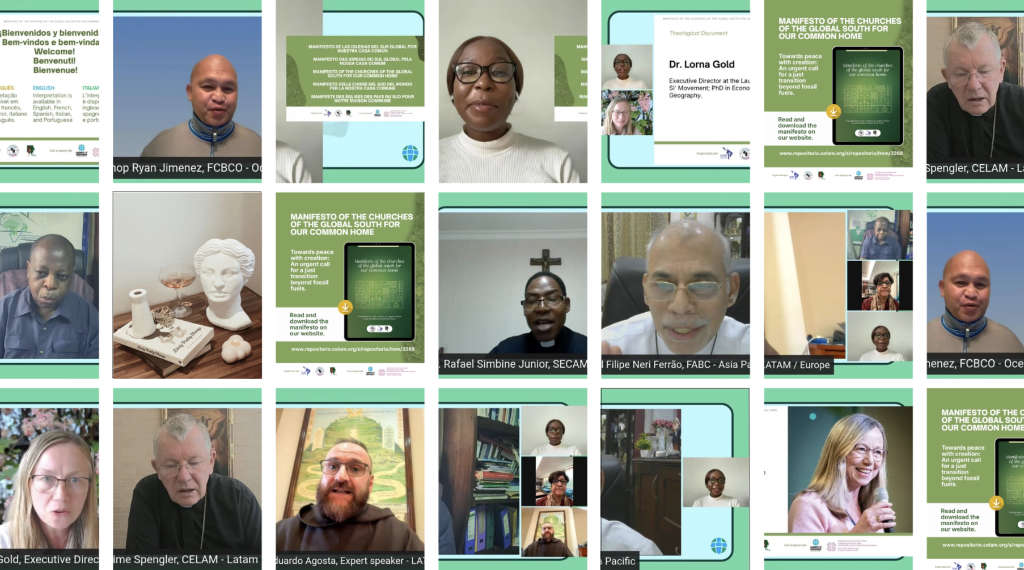
Leaders from across the Catholic Church gathered in a global webinar this week to present a powerful new call for climate justice: the “Manifesto of the Churches of the Global South for Our Common Home: Towards Peace with Creation – An Urgent Call for a Just Transition Beyond Fossil Fuels.”
Bringing together voices from Africa, Latin America and the Caribbean, Asia, Oceania, and Europe, the event created a shared space for bishops, theologians, and climate advocates to reflect on the Church’s growing role in addressing the climate crisis.
More than 1,000 participants from around the world joined the historic online gathering, united by a common concern: the need to move beyond fossil fuels while protecting vulnerable communities and ensuring a just transition for workers and families.
A prophetic call from the Global South
The manifesto was presented by cardinals and bishops representing continental episcopal bodies, who emphasized the urgent need for decisive global action to address the climate crisis and protect our common home.
Jaime Spengler, Cardinal and President of the Latin American and Caribbean Episcopal Council (CELAM), spoke about the deep pastoral urgency behind the document.
“This manifesto responds to an economic model and technocratic paradigm that have produced an economy that kills, based on unsustainable patterns of consumption. The Paris Agreement, while important, is not enough.
For the Church and our region, this manifesto means raising a prophetic voice, promoting ecological and cultural conversion, strengthening political advocacy, and renewing the preferential option for the most vulnerable.”
From Africa, Fridolin Ambongo Besungu, Cardinal and President of the Symposium of Episcopal Conferences of Africa and Madagascar (SECAM), emphasized that justice must remain at the center of the global energy transition. His message was delivered by Father Rafael Simbine Jr.
“A just transition must ensure that the dignity of people and the protection of creation remain at the center of global decisions. Africa has suffered serious setbacks due to projects that expose the vulnerability of many communities, putting both populations and the planet’s biodiversity at risk.”
A global call for solidarity
In Asia, the realities of industrial growth and climate vulnerability intersect in complex ways. Filipe Neri António Sebastião do Rosário Ferrão, Cardinal and President of the Federation of Asian Bishops’ Conferences (FABC), highlighted the urgency of international cooperation.
“We are living in a time that urgently demands a fossil fuel treaty. Asia faces diverse realities: large industrial centers dependent on coal coexist with coastal and rural communities already impacted by rising sea levels. This document calls us to denounce false market solutions and demand the phase-out of fossil fuels while protecting communities currently dependent on fossil fuel industries.”
European leaders also underscored their responsibility in the global transition. Ladislav Nemet, representing the Council of European Bishops’ Conferences (CCEE), stressed the importance of shared action across continents.
“Europe and Oceania are committed to supporting this shared struggle. When we act together, our response becomes more effective. The geopolitical tensions we face today—and their consequences for the climate—are serious and alarming. The call to act together has never been more urgent.”
For island nations in Oceania, climate change is not a distant threat but a daily reality. Ryan Jimenez, Bishop and President of the Federation of Catholic Bishops’ Conferences of Oceania (FCBCO), reflected on the existential stakes for many communities.
“For many of our peoples, the question of our common home is not an abstract idea. It is a daily reality that affects lives today and threatens the future of generations to come.”
Read the manifestoA theological reflection on fossil fuels
During the webinar, the Laudato Si’ Movement also presented a new resource: “Theological Foundation: A Catholic Theological Reflection on the Proposal for a Fossil Fuel Treaty Initiative.”
The document offers a moral framework for Church leaders and Catholic institutions, explaining why limiting fossil fuel production aligns with Catholic social teaching, particularly in relation to the principles of justice, peace, prudence, and the protection of life.
Lorna Gold, Executive Director of the Laudato Si’ Movement, emphasized the importance of grounding climate action in the Church’s moral tradition.
“This theological reflection helps clarify why addressing fossil fuel expansion is not only a political or economic issue, but also a profound moral and spiritual question. Catholic social teaching calls us to protect life, uphold justice, and act with prudence in the face of grave risks to our common home.”
She also noted that faith communities have an essential role to play in encouraging ethical leadership and supporting policies that move the global economy toward sustainable energy systems.
Download the Theological ReflectionLooking ahead
The webinar also featured contributions from regional experts, including Jean D’Cunha from Asia, Jesuit priest Rigoberto Milano from Africa, and Fray Eduardo Agosta from Latin America.
Participants highlighted the upcoming Santa Marta Conference on Just Energy Transition, which will take place in Santa Marta, Colombia from April 24–29, as an important moment for continued dialogue and collaboration.
The gathering concluded with a renewed call for governments, civil society, and faith communities to work together to advance peace with creation and protect our common home.
More about the Fossil Fuel treaty