





One mother’s journey to give her daughter a future rooted in nature and hope
Meet Paola, a Laudato Si’ Animator from Ecuador and mother to seven-year-old Isabelle. Both Paola and her husband work in natural conservation, and their approach to raising Isabelle shows us that creating a relationship with nature starts with simply being in it.
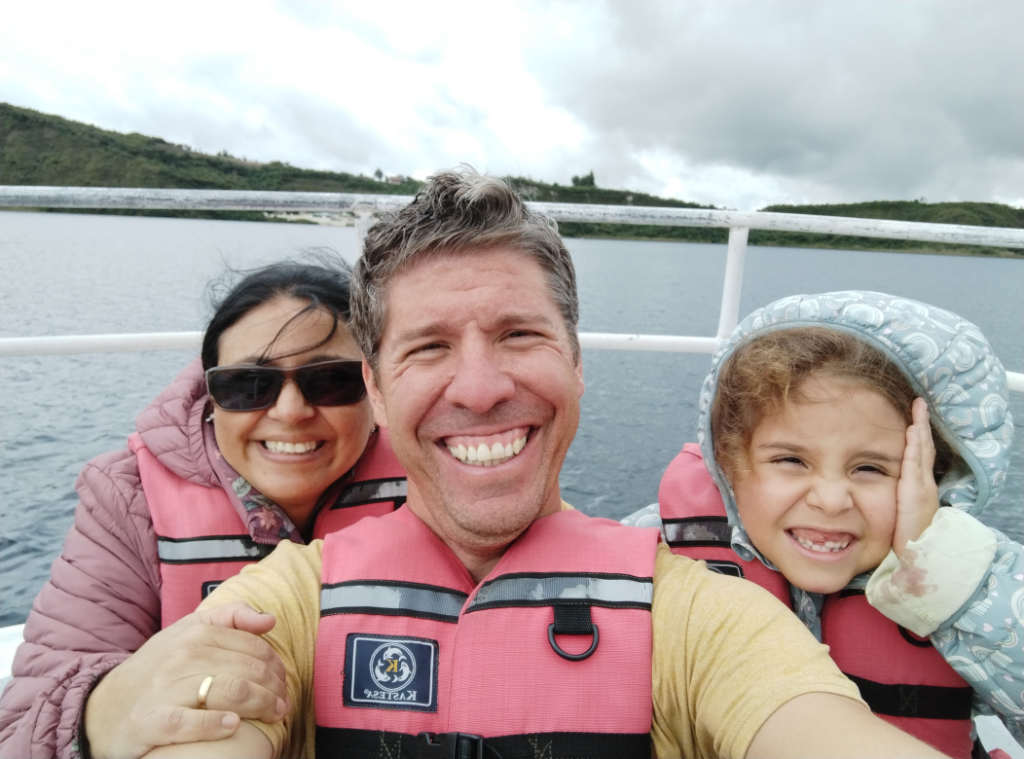
Paola, her husband and Isabelle exploring nature
LSM Team: Hi Paola, can you tell me a bit about yourself and your family? How many kids do you have, and how old are they?
Paola: I have one child, a daughter named Isabelle. She’s seven years old, and she loves nature. My husband and I both work in natural conservation. He’s a forest conservation engineer, and I’m an Agricultural Engineer specializing in watershed management. I work as a Natural Resources consultant, focusing on ecosystem conservation and sustainable agricultural production. I’m also part of the SOMOS Foundation, which works on development projects with rural communities. And I volunteer with the Laudato Si’ Movement in Ecuador, as part of the coordinating team. Isabelle has always accompanied us in what we do. She’s grown up surrounded by this work.
LSM Team: What first drew you to creation care? Was there a specific moment that made you think, this actually matters?
Paola: I was always worried about the state of our planet, but it became much more personal when Isabelle was born. Around that time, I received an invitation to learn about the Laudato Si’ Movement, and it became like a path of hope for me, a way to understand the role each of us play in the care of creation. Through the program, I found tools that allowed me to share this message with others, both on an academic level and through the example I set with my own family.
LSM Team: How has being a parent shaped the way you approach creation care?
Paola: It made it urgent. When I became a mother, I was scared not just for Isabelle, but for all children. I want her to have a future. And I believe the way to give her that future is to show her an alternative world: one where we are connected to nature, where we protect it, where we understand that we are part of it. My husband and I are always looking for natural spaces to take her, so she can build that relationship early. If she loves nature, she will want to protect it. That’s the foundation.
“If she loves nature, she will want to protect it. That’s the foundation.”
LSM Team: What are some small, practical things you’ve changed at home that Isabelle has noticed?
Paola: We always separate our trash and recycle. We try to buy unprocessed foods, fruits, vegetables, and we shop at local markets rather than large supermarkets, to support smaller producers. We bring our own containers when we go out to avoid plastic. We’re very intentional about not over-consuming, and really thinking about what we actually need before we buy anything. There’s also a project at Isabelle’s school around reuse and sustainability, which reinforces what we do at home.
And one thing that really warms my heart is that Isabelle spends so much time in nature that she’ll go outside in the rain and just get completely soaked, and she’s happy. That connection is real. And I think when a child truly enjoys nature like that, they naturally understand why it’s worth protecting.
LSM Team: Has Isabelle surprised you with her own questions or ideas about caring for creation?
Paola: She’s very curious about everything. When she encounters something she doesn’t understand, she goes looking for answers. For example, she became very interested in the water cycle — where rain comes from, how it works, and the water problems we face here in Ecuador. By understanding the process, she also understands why we need to take care of water. She connects the knowledge to the action.
She also plays games with her friends that involve searching for information about nature and creation care, which I find beautiful. We’ve bought her books on the subject, and she loves animated series about different animal species and the environment. She integrates all of it — the books, the shows, the time outdoors, the conversations with us, and it all deepens her understanding of her relationship with nature.
LSM Team: How do you talk to Isabelle about climate change without overwhelming her or making her anxious?
Paola: I try to be honest with her, but I follow her lead. When she asks a question, I answer that question. I don’t go deeper than what she’s asking, so I’m not adding fear beyond what she’s ready for. And I always try to give her an alternative, a solution.
For example, we visited a park where she learned that some frog species are becoming extinct. That could have been very upsetting. But I told her: yes, this is a problem, but look, what we can do is plant more in our garden, so these species have a place to come. There is always something we can do. I want her to understand that our actions matter, and that there are answers, not just problems.
“I want her to understand that our actions matter, and that there are answers, not just problems.”
LSM Team: Have you found ways to connect creation care to your family’s faith and prayer life? What does that look like for you?
Paola: We’ve always been a family of faith, both on my side and my husband’s. But now I understand the connection between faith and nature on a much deeper level. When I spend time in nature, I pray, I give thanks. Something as simple as waking up in the morning and hearing the birds sing fills me with such gratitude, and that gratitude becomes prayer. I feel like being in nature is itself an act of worship.
My husband loves to climb mountains, and we have so many here in Ecuador. He says that when he’s up there, he feels closest to God. He can truly feel God’s presence in nature. And I think that’s it exactly: nature offers the same peace that God offers, because it is His creation. That’s the connection for us. Nature offers the peace that is offered by God.
LSM Team: What advice would you give to other parents who want to raise their kids with creation care values but don’t know where to start?
Paola: Take them to nature. That’s the first step. Find the natural spaces closest to you and bring your children there. Let them experience it directly. I truly believe that children are naturally drawn to nature and we are all born connected to it, and that instinct is still there. Once a child has that experience, they start asking questions. They start noticing. And something beautiful happens: children are calmer, more at peace, and genuinely happier when they’re surrounded by nature. Sometimes we as parents want to protect them from getting muddy or wet, but that’s actually us pulling them away from something they need. It’s returning to our roots.
And honestly, it’s good for us as adults too, to remember how we played as children, to feel that connection again ourselves.
There is no platform, no course, no book that can substitute for actually being in nature. You cannot fully understand why creation matters unless you are directly connected to it. When you’re disconnected from it, it’s very hard to understand why it needs protecting. But when a child is out there playing with flowers, watching insects and exploring, that’s when it becomes real for them. That time in nature is everything. It is the only true starting point.
“There is no platform, no course, no book that can substitute for actually being in nature.”
We’re deeply grateful to Paola for showing us what it means to raise a child rooted in nature and hope. Her witness reminds us that the path to caring for creation begins with experiencing it directly—letting our children get muddy, explore freely, and discover the peace that nature offers. Thank you, Paola, for being part of this movement and for raising Isabelle to love what she protects.