





By Daniel Castellanos, Eco-conversion Programs Manager
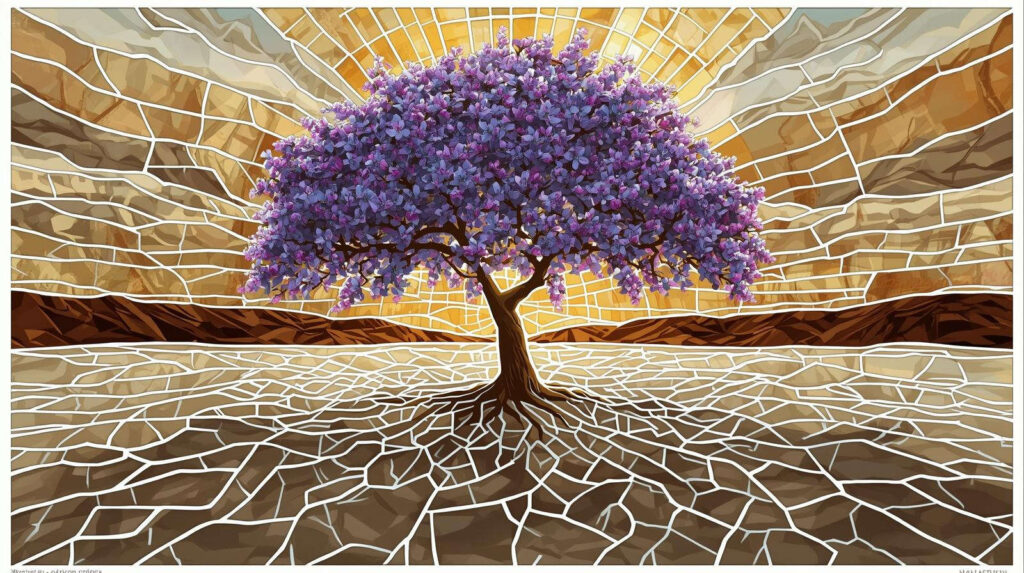
A few days before the beginning of Lent, in eastern Guatemala—part of Central America’s Dry Corridor—the dry season has stretched on for months. The air burns, and everything seems thirsty. While much of the vegetation gives in to the drought, the guayacán trees (Guaiacum sanctum, commonly known as Lignum Vitae or Holywood), defiant, remain green and clothe themselves in violet blossoms. It is precisely when the landscape is at its driest that the guayacanes reveal their full beauty.
At this time of year, these trees become among the last refuges for other living beings. Their secret lies in depth: a primary root that plunges vertically to reach deep underground waters.
Growing Inward Before Growing Outward
The Gospel for this Ash Wednesday offers us a clear invitation: that our almsgiving, our prayer, and our fasting be carried out from the depths of the heart, from intimate communion with the Father, “…and your Father, who sees in secret, will reward you” (Mt 6:4).
Faced with the temptation to live on the surface, we are called to return to the heart. As Pope Francis reminds us in Dilexit Nos (2):
Living as we do in an age of superficiality, rushing frenetically from one thing to another without really knowing why, and ending up as insatiable consumers and slaves to the mechanisms of a market unconcerned about the deeper meaning of our lives, all of us need to rediscover the importance of the heart.
The guayacán survives because it is not enslaved by haste. Its slow growth—sometimes only a millimeter per year—rebels against immediacy. The Gospel invites us to go deeper, to the place where we find the Source that enables us to remain standing when the desert intensifies.
Jesus criticizes those who seek to be seen but are dry within. The guayacán, by contrast, does not waste energy growing quickly to impress anyone; it builds its strength through a wise metabolic decision: growing inward before growing outward.
Lent as a Time to Exercise the Heart
Lent is a privileged time to strengthen this bond with the Creator and to allow the heart—scattered and fragmented—to be brought back into unity.
In prayer we encounter the Living Water (Jn 4:14) that sustains our hope as socio-ecological crises deepen. In fasting we free ourselves from what is superfluous to make room for what is essential. In almsgiving we recognize that we exist in interdependence, and that our lives find meaning when they are offered as a gift.
The guayacán reminds us that, even in aridity, life is possible when it is well rooted. From this wisdom arises the call of this week’s Laudato Si’ Goal: to cultivate an ecological spirituality born of the heart, because “only by returning to the heart can a true ecological conversion take place” (Pope Leo XIV).
Returning to the heart transforms the way we inhabit the world, helping us to distinguish between what is necessary and what is superfluous. A spirituality that flows from the heart inevitably leads to a life that is more sober, more just, and in harmony with the limits of creation.
Ecological Spirituality and the Laudato Si’ Goals
The guayacán does not grow beyond what it can sustain. Its strength does not lie in unlimited expansion, but in self-restraint—in knowing how far to grow in order to continue giving life.
Fasting is to learn this same wisdom, breaking with the inertia of “more is better” and moving toward “better with less.” It is to be able to say freely, I have enough to be happy.
Lived in this way, in both the intimate and the social dimensions, fasting becomes an act of justice. We fast from what we have in excess so that the Earth may rest and so that the poor may have what they need. This is not an empty sacrifice, but a concrete practice of care on a finite planet wounded by excess and excessiveness. Self-restraint, like that of the guayacán, is not a denial of life, but a choice for a way of living that leaves room for others. It is self-mastery in the service of life.
Christ, the Heart of the World
Finally, this return inward reveals to us that Christ is the Heart of the world (Dilexit Nos 31, 81). His Sacred Heart is the unifying principle of all reality, the place where creation, humanity, and divine love converge. To return to the heart, then, is to return to His. And to love His Heart is, inevitably, to learn how to care for all that He loves.
For all these reasons, it is worth beginning Lent by asking ourselves honestly: What has distracted my heart from what truly gives life, and how is God inviting me to return to the heart—His and my own?