





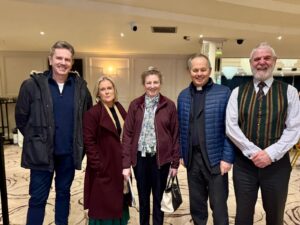
Bishop Martin Hayes with some of the Kilmore Care for Creation group (credits: Finbarr Keaveney).
Up to 200 people from all over the island of Ireland attended the Care for Creation conference in Newry’s Canal Court Hotel on Saturday 17 January 2026. Organised by the Irish Council of Churches, and the Irish Inter-Church Meeting, they invited people to engage with the theology, science and experience of climate crisis, especially visible in the pollution affecting Lough Neagh, a particular focus of the conference.
It was a great way to strengthen the collaboration across Christian denominations, both in the organising and on the day, building unity around the climate crisis and bringing the richness of experience from Trócaire and the Laudato Si’ Movement into conversation and planning. There were parish groups with Laudato Si Animators from many parts of Ireland present, and it was lovely to see the enthusiasm to build relationships and continue working together as they met in person.
The three key speakers – Dr Hilary Marlow from Cambridge spoke on the biblical basis and theological grounds for care for creation, and referenced Pope Francis’ encyclical Laudato Si’, a text worth studying across the Christian denominations, she encouraged. Professor Jim McAdam from Queen’s University spoke on Lough Neagh, the pollution, the physical qualities and scale of the area, the impact of the pollution on the local communities, and the nature-based solutions that are available for people to act upon. Dr Gail Heffner from Calvin University shared about reconciliation ecology – acknowledging the damage and impact of pollution on communities, with regards to the Michigan river she was working with. Forming a local community action group, the Plaster Creek Stewards, they brought people together to heal and work on solutions that deal not only with the “surface pollution” of the river, but more systemic issues that led to pollution in first place. (Slides from the conference speakers will be available on the Irish Council of Churches website – www.irishchurches.org).
Andrew Muir, Northern Ireland’s Environment minister, joined the conference and spoke about the political and legislative responsibilities he and other members of the Northern Ireland Assembly must engage and work with the communities affected by Lough Neagh’s pollution. He outlined his engagement with the various stakeholders, and updated the gathering on the Lough Neagh plan, and how 15 of the recommendations from the plan have been implemented. Acknowledging the difficulties, he also promised to work in partnership to pass Lough Neagh to future generations in a better state than it is right now.
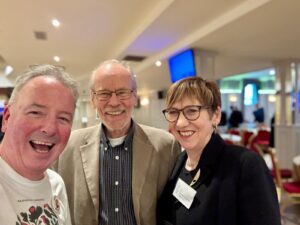
Finbarr Keaveney with Edwin Graham NI Interfaith Forum and Niamh Society of Friends representative on Eco-Congregation Ireland (credits: Finbarr Keaveney).
The panel discussion in the afternoon was varied and gave people a lot to consider – Eco-congregation Ireland presented their award system and showed a variety of ways parishes engaged with this work, while Professor Roy Douglas spoke from the Moravian church in Ireland, a smaller denomination’s experience, and brought his scientific background into the discussion. Róisín Nic Cóil talked about the energy audit undertaken by Archdiocese of Dublin on their building stock (churches, parish halls etc), and Maureen Rowan from the Methodist church in Dublin 6 shared about the practical effort to be eco-friendly in a parish, as a volunteer, and some of the energy stats and funding available that they tapped into to make significant changes in energy use and efficiency.
The liturgical moments included the “Prayer for 7 directions” from Trocaire’s “Listening to Nature” resource, a prayer of lament using a bowl of Lough Neagh water led by Archbishop Eamon Martin and Bishop Sarah Groves (President of ICC), and music from a band of three musicians added to the prayerfulness of these moments. The final liturgy involved moving from lament to hope, using a symbolic “river of hope” and pledges of action made by those attending the conference. Water brought from around Ireland was poured into the bowl, including rivers from Cork, Dublin and the Sperrin mountains in Northern Ireland, along with glacial water from Greenland blessed by Pope Leo XIV at the Raising Hope conference in Rome in October 2025, and pledges of action were read. The buzz of atmosphere at the end showed how people were inspired and enjoyed the day.
Looking to the future, participants were encouraged to support initiatives addressing the roots of the crisis, including advocacy for a Just Transition and engagement with the Fossil Fuel Non-Proliferation Treaty.
There was also a strong call to prepare for the Season of Creation 2026, which will focus on the theme “Living Water.” For faith communities around Ireland this offers a concrete opportunity to deepen education and action around water as a source of life, communion and justice. This could even be something that could be built up slowly over time, incorporating and highlighting water in liturgy over the next few months.
Archbishop Eamon Martin recalled the Irish saying: Ní neart go cur le chéile—there is no strength without unity. The Newry conference served as a powerful reminder that when we walk together, listening, learning and acting, even small steps can become a living current of hope.
Write-up by Róisín Alexander-Pye
Laudato Si’ Officer – Ireland