



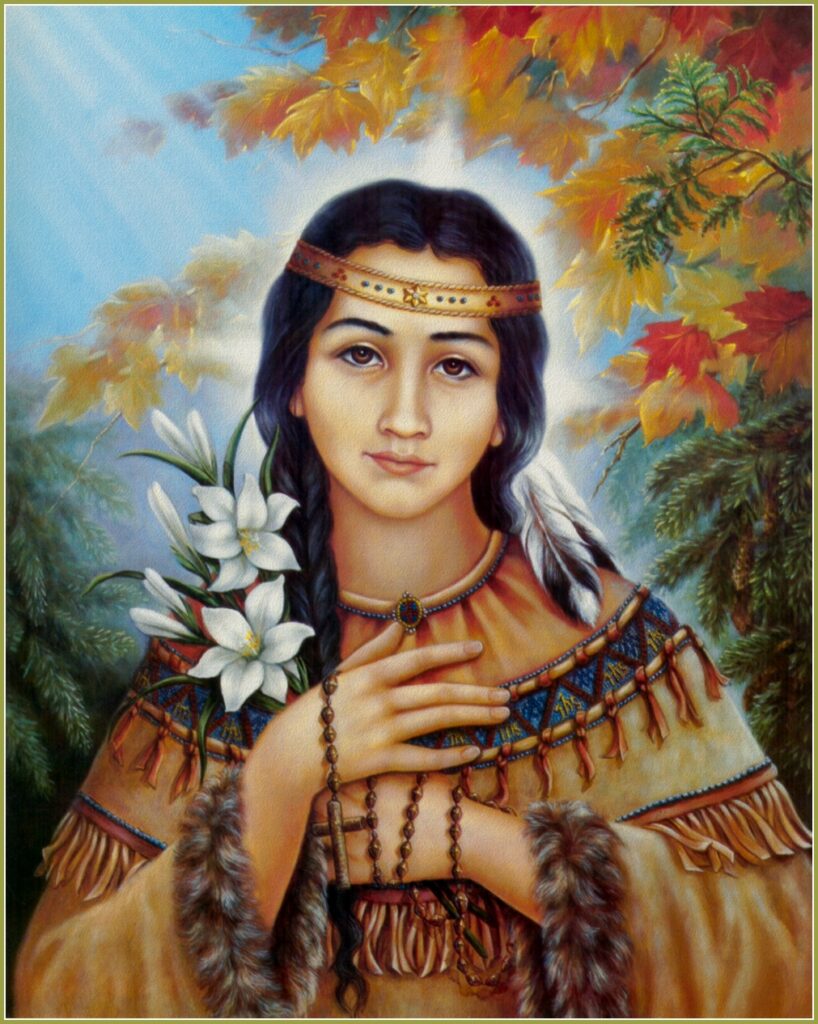
This July 14 we remember one of the saints of ecology. Saint Kateri Tekakwitha was 20 years old when she was baptized, yet her life illuminates the way for all those who seek to live in greater communion with creation.
In July of 1677, Tekakwitha was being treated as an outcast in her community and receiving threats because of her faith. So she traveled for two months and over 200 miles of forests and rivers to the Catholic mission of St. Francis Xavier at Sault Saint-Louis in Canada.
There, Tekakwitha lived with other indigenous Catholics and continued to dedicate her life to God. Her legacy is honored today by many organizations, including the Saint Kateri Conservation Center, which helps organizations and families turn their plots of land or backyards into healthy habitats that honor the life of the patron saint of Native American and First Nations peoples, ecology and the environment.
St. Kateri Tekawitha was the first Native American Catholic saint. She was born in 1656, in the Mohawk village of Ossernenon. At the age of four she contracted smallpox, which left her face severely scarred. As her entire family succumbed to smallpox, she went to live with her uncle, who was the chief of the Mohawks.
She helped her aunts work in the fields where they grew corn, beans and squash (the “Three Sisters”) and took care of the traditional house in which they lived. She also collected firewood in the forest and plants to make medicines and dyes. She collected water from the streams and springs that bubbled up from the ground. Despite her poor eyesight, Kateri became an expert in bead making.
At the age of 19, Kateri converted to Catholicism, taking a vow of chastity and promising her life to Jesus. This decision, of course, was not well received by the inhabitants of the village where she lived. When rumors began to spread that she was engaged in witchcraft, she traveled to a community of native Christians in Montreal to avoid persecution.
Kateri, whose health was always weak, died on April 17, 1680, after a long illness. She was 24 years old. Her pious existence did not end with her physical death. Three people had visions of her in the week following her death. A chapel was built near her tomb and soon pilgrims, both indigenous and European, began to arrive to give thanks to God for this holy woman.
In December 2011, following the testimony of a child whose infection was cured by praying to Tekakwitha for her intercession, Pope Benedict XVI recognized her as a saint. She was canonized in October of the following year. There are many accounts of miracles attributed to Kateri’s intercession, which continue to this day.