






By Ashley Kitisya, Director of Africa with Fossil Free Advocacy Portfolio
Faith communities are standing at a historic crossroads in the lead‑up to the Santa Marta conference. Around the world, people of many religions are joining forces through the Faiths for a Fossil Free Future (FFFFF) coalition to confront the root causes of the climate crisis and call for a rapid, just transition away from fossil fuels.
A multifaith rising for climate justice
FFFFF brings together Bahá’í, Buddhist, Catholic, Evangelical, Hindu, Jewish, Muslim, Protestant and other spiritual traditions around a shared conviction: the era of fossil fuel expansion must end, and a well‑funded, fair transition to renewable energy must begin. This multifaith coalition builds on years of faith advocacy for a Fossil Fuel Non‑Proliferation Treaty, a proposed global agreement to stop new coal, oil and gas projects, phase out existing production equitably, and secure a just transition for workers and communities.
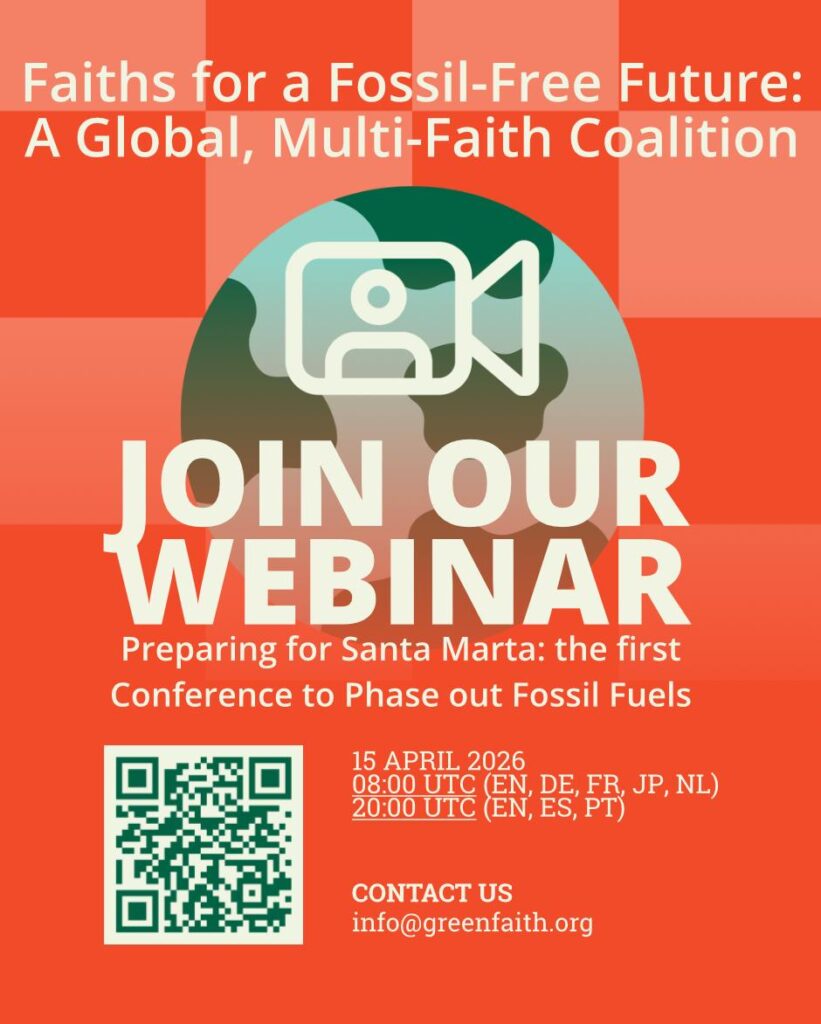
On 15th April, FFFFF gathered religious leaders and grassroots communities from every region to share testimonies of climate impacts, articulate common demands, and to prepare for the First Conference on Transitioning Away from Fossil Fuels in Santa Marta, Colombia, co‑hosted by the governments of Colombia and the Netherlands. For many participants, this space has become a place of grief, courage, and hope: local stories of floods, fires, drought and displacement are met with a shared moral insistence that this crisis is not inevitable, but the result of decisions that can and must change.
Catholic foundations: Manifesto and theological reflection
For Catholic actors, this multifaith engagement is deeply rooted in the Church’s own recent discernment. The Manifesto of the churches of the global south for our common home offers a clear moral framework for ending fossil fuel expansion, phasing out existing production, and promoting a global just transition grounded in justice and solidarity. Complementing this, the theological reflection inspired by Laudato Si’ and Laudate Deum links fossil fuels directly to the cry of the poor and the cry of the Earth, showing why limiting fossil fuel production is not optional, but a demand of integral ecology and Catholic social teaching.
Within FFFFF, Catholic institutions such as Laudato Si’ Movement walk alongside other faith partners to embody these convictions publicly: supporting the Fossil Fuel Treaty, advancing fossil fuel divestment, and amplifying the voices of communities on the frontlines of extraction and climate breakdown.
Santa Marta: from “if” to “how fast”
The Santa Marta conference is the first intergovernmental meeting dedicated specifically to transitioning away from fossil fuels, bringing together dozens of governments along with civil society, Indigenous Peoples, faith communities, workers and other stakeholders. For FFFFF, this is a crucial moment to shift the global conversation from “Should we act?” to “How fast and how fairly can we move?”
FFFFF engagement – take action
The climate crisis is a call for people of all faiths and traditions to come together in care for our common home. Unite with the wider faith movement by taking action and supporting the multifaith call for a Fossil Fuel Treaty.
Sign as an individual: https://actionnetwork.org/forms/multi-faith-letter-2?source=lsm
Sign as an organization: https://actionnetwork.org/forms/multi-faith-letter?source=lsm
Watch the 15 April Multifaith call recording here https://drive.google.com/file/d/1ED1lxPPMf2hBH-p_uoYX-7-Z6tcaOVBK/view?usp=sharing
As Santa Marta approaches, we invite all Catholic communities and partners of Laudato Si’ Movement to pray, speak, and organize so that this conference becomes a real turning point; where the multifaith moral call for a fossil‑free future is heard, and concrete pathways away from fossil fuels are set in motion.