





BY: Mwenya Chitambala
Africa is central to the global energy transition. But as the world moves away from fossil fuels towards renewable energy, an important question remains: will this transition deliver justice, development and greater sovereignty for African communities?
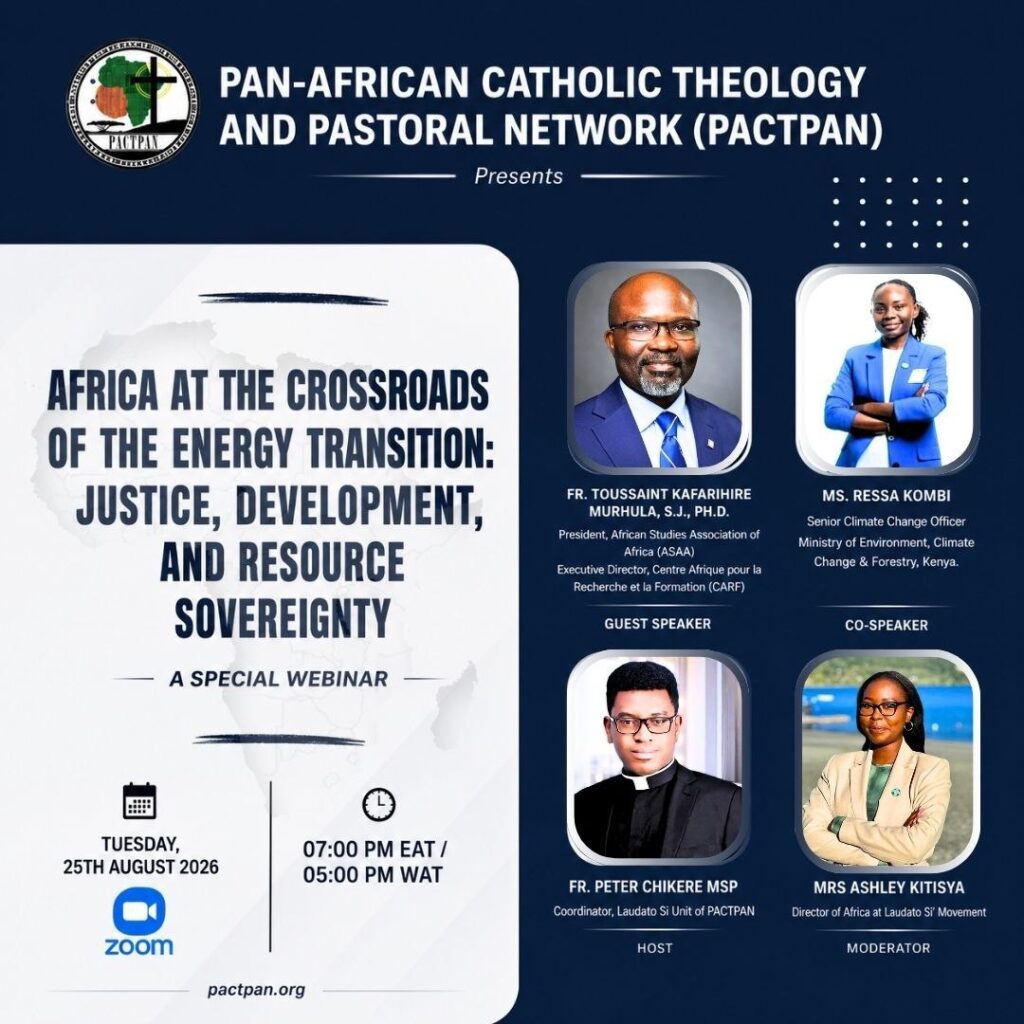
This question was at the heart of the online webinar, “Africa at the Crossroads of the Energy Transition: Justice, Development, and Resource Sovereignty,” hosted by the Pan-African Catholic Theology and Pastoral Network (PACTPAN) on 25 August 2026. The discussion explored how Africa can participate in the global transition while ensuring that its resources contribute to local development, protect communities and creation, and benefit African people.
Hosted by Fr Peter Chikere MSP, Coordinator of PACTPAN’s Laudato Si’ Unit, and moderated by Ashley Kitisya, Director of Africa at Laudato Si’ Movement, the conversation brought together Fr Toussaint Kafahire Murhula, SJ, PhD, and Ressa Kombi, Senior Climate Change Officer at Kenya’s Ministry of Environment, Climate Change and Forestry.
Africa has enormous renewable energy potential and many of the critical minerals needed for batteries, electric vehicles and other technologies driving the global transition. Yet this opportunity presents a difficult paradox. Many African economies remain dependent on extractive industries, while growing demand for critical minerals risks reproducing a familiar pattern in which Africa supplies raw materials while much of the processing, manufacturing and economic value remains elsewhere.
Fr Toussaint challenged participants to consider whether Africa will remain primarily a supplier of resources or use this transition to change historical patterns of dependency. A transition that simply replaces one form of extraction with another cannot automatically be called just.
As Fr Peter emphasised, the question is not simply whether Africa should transition, but how. A just transition must strengthen local industries, create decent employment, improve energy security and ensure African countries and communities benefit from their resources.
Drawing on Laudato Si’, the discussion placed integral ecology at the centre. The success of the transition cannot be measured only by renewable energy generation or declining emissions. We must also ask: Who benefits? Who carries the cost? Are affected communities able to shape the decisions that determine their future?
Ashley Kitisya emphasised the connections between justice, policy, economics, human dignity and care for creation, while Fr Toussaint drew on the African principle of Ubuntu as a call to responsibility towards one another, creation and future generations.
For Laudato Si’ Movement, moving away from fossil fuels is necessary, but participation alone is not enough. Africa must help shape a renewable energy future that protects our common home, strengthens African agency and places the dignity of people and communities at its centre.