


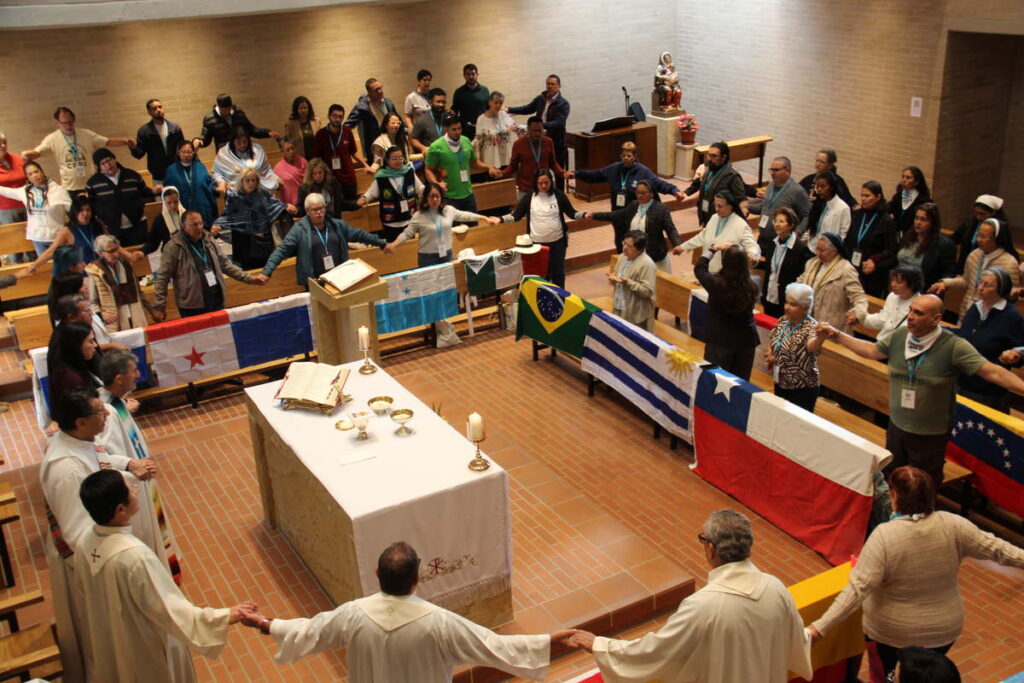
110 participants from 19 countries gathered from October 1–4 at the headquarters of the Latin American and Caribbean Episcopal Council (CELAM) in Bogotá to collectively discern the future of the Laudato Si’ Movement in the region. The Encounter concluded on Sunday, October 4, the Feast of Saint Francis of Assisi, with the launch of a Regional Manifesto and a Sending Mass.
Bogotá, Colombia, October 2, 2026. — With the participation of 110 Laudato Si’ Animators, volunteers, and Movement members from 19 countries, Laudato Si’ Movement’s First Hispanic American Encounter began in Bogotá, providing a historic space to come together, listen, and discern how to strengthen the journey of ecological conversion across the region.
The day began in a spirit of prayer. The celebration of the Eucharist opened the Encounter by recalling the importance of walking together and recognizing God’s presence within the community. From that very first moment, one word began to permeate the conversations: synodality.
The joy of meeting in person after months of preparation was evident from the opening. Each delegation was welcomed with the recognition that every person arrived in Bogotá carrying a story, a community, and a hope. Together, these stories formed what was described during the welcome as a “living map of our Common Home: many voices, one mission”.
The community gathered was even larger than those physically present in Bogotá. Nearly 300 volunteers joined the livestreams and accompanied the Encounter from afar, many of them also through prayer, extending this shared journey beyond the walls of the auditorium.
An Important Moment for the Movement
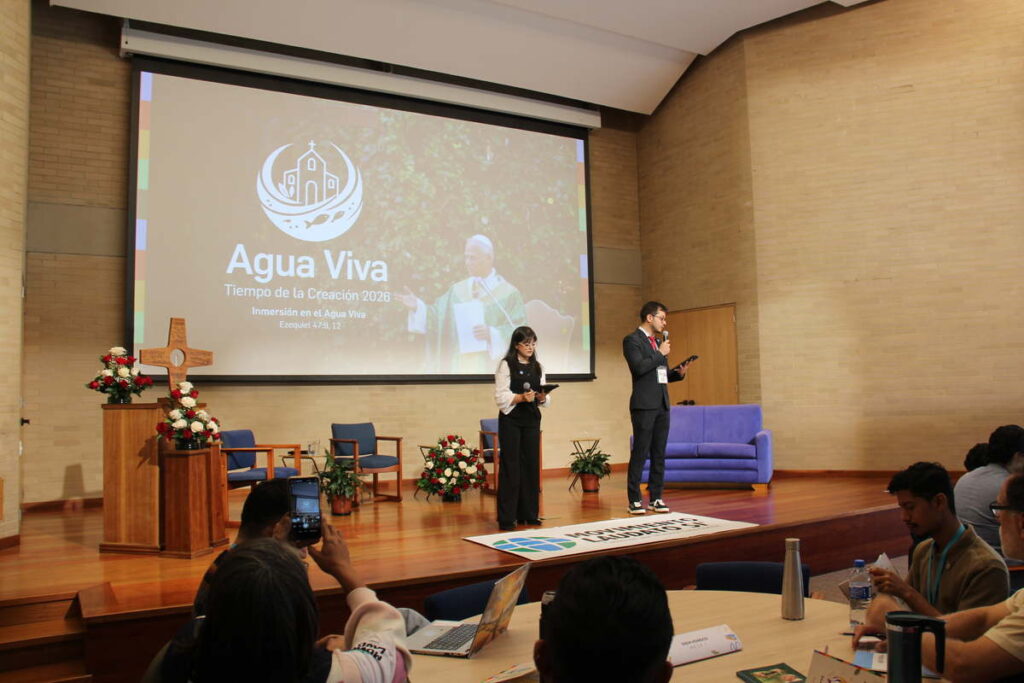
The Encounter comes at a significant moment for the Laudato Si’ Movement. The recently approved 2030 Strategic Roadmap, enriched by the conversations and processes of the 2024 and 2025 encounters, will guide the Movement toward its vision for 2035.
More than an organizational document, it was presented during the opening as an invitation to imagine together the Movement and the Church we want to help build: communities where ecological conversion is not merely an individual decision, but a reality lived out in families, parishes, communities, and territories.
The opening was also marked by the first anniversary of the Raising Hope conference, held in Castel Gandolfo with Pope Leo XIV. That moment was brought to life again in Bogotá through a special symbol: a cross containing water from a block of ice from Greenland, blessed by the Pope on October 1, 2025.
Since then, this symbol has accompanied different moments along the Movement’s and the Church’s journey for climate justice, traveling from Christ the Redeemer in Rio de Janeiro, to the National Shrine of Aparecida, COP30 in Belém, and Santa Marta, before now arriving at the First Hispanic American Encounter in Bogotá.
Amid this moment of remembrance and looking toward the future, a biblical image accompanied the invitation to recognize what each person can contribute: the five loaves and two fish.
What are the five loaves and two fish that we are called to place in God’s hands today?
Our time, our experience, our creativity, our talents, and our willingness to serve. We do not need to know exactly what the future will look like in order to begin building it. As in the Gospel, what may seem small can multiply when we place it at the service of others.
From Rome, Sr. Alessandra Smerilli, Prefect of the Dicastery for Promoting Integral Human Development, sent a message of closeness to the Encounter, assuring participants that the Dicastery is accompanying this journey. Her message also offered three verbs for the path that is beginning: measure, walk, and sow.
From Synodality to Eco-Synodality
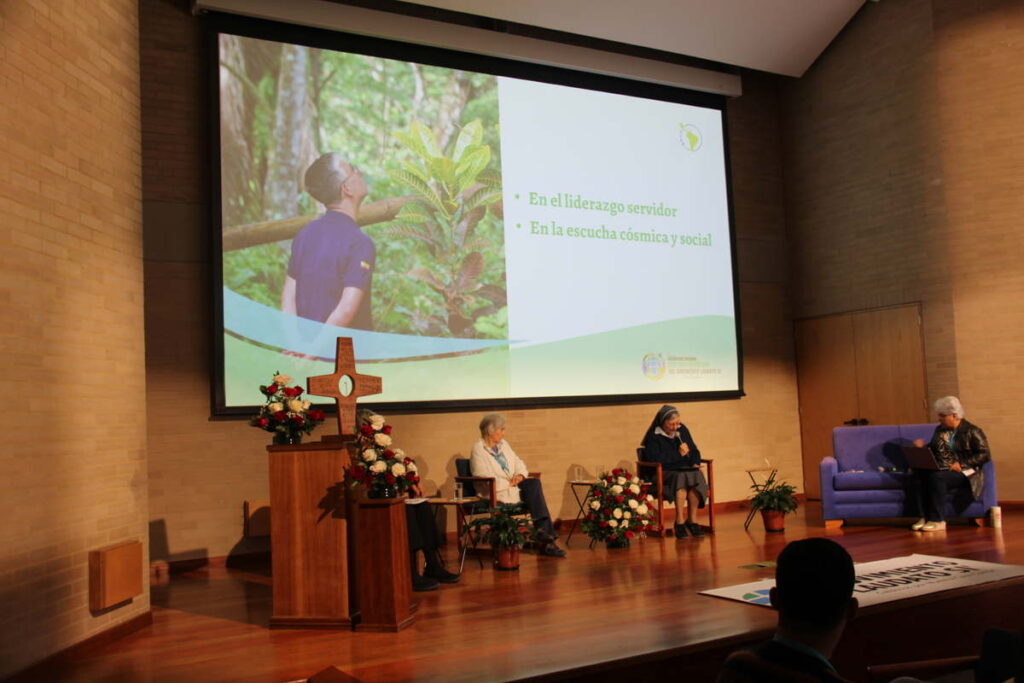
The first panel, “Walking Together: Living Synodality Through the Lens of Integral Ecology (Eco-Synodality)”, explored a fundamental question: What does it mean to truly be a synodal movement?
The panel featured María Lía Zervino, a member of the Synod Council and the Board of Directors of the Laudato Si’ Movement; Sister María Inés Castellaro, General Secretary of the Latin American Confederation of Religious (CLAR); and Fr. Francisco Hernández, a member of the CELAM Synod Commission for 2021–2024. The conversation was moderated by Sulman Hincapié of the World Council of Members of the Laudato Si’ Movement.
The reflection revisited the path opened by the Second Vatican Council and the development of the Church’s synodal experience, including the impetus provided by Pope Francis when he commemorated the 50th anniversary of the establishment of the Synod of Bishops in 2015.
But the conversation went beyond history. It invited us to ask how synodality can transform the way we relate to one another, our communities, our institutions, and the Movement itself.
From the perspective of integral ecology, this act of listening also takes on a broader dimension: it does not end with the human voice. We are called to listen together to the cry of the Earth and the cry of the poor—an invitation that has been present since the opening of the Meeting, as we recalled the legacy of Laudato Si’.
And so, one question began to resonate throughout the day:
How does a movement change when it truly learns to listen—to the Spirit, to people, and to creation—and allows itself to be transformed by that listening?
Listening with an open heart
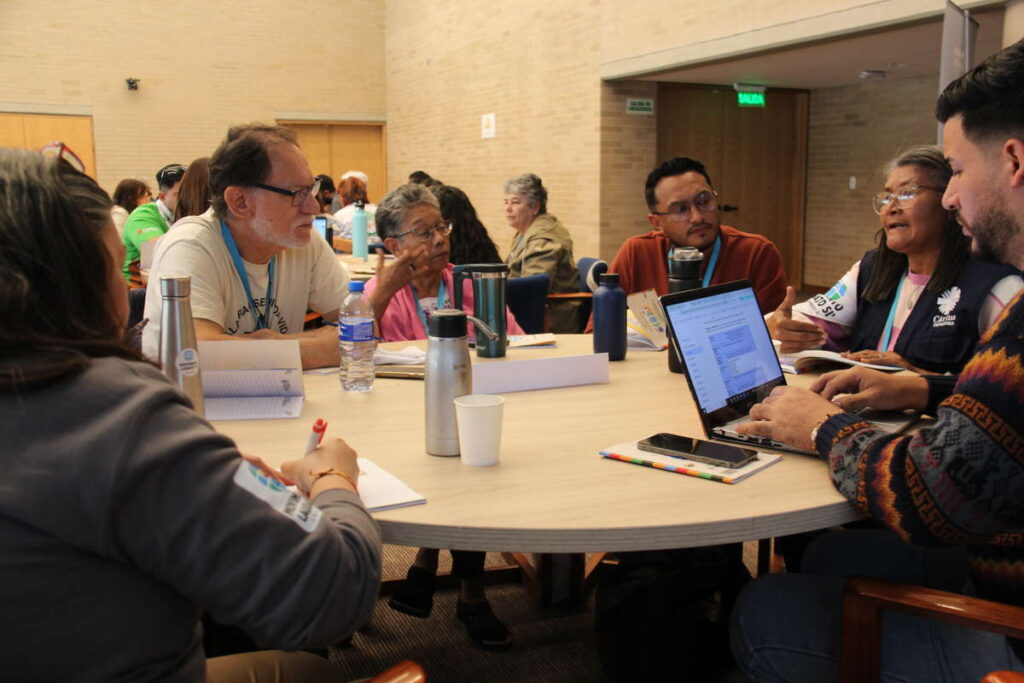
After the panel discussion, the participants moved from talking about synodality to experiencing it through Conversations in the Spirit.
Seated at tables arranged to foster diversity of experiences and backgrounds, they were invited to come together and “listen with open hearts”, being mindful of the time and ensuring that all voices had a chance to be heard.
One question guided this discernment:
“What changes are we called to make so that we can walk together and strengthen a more synodal way of being the Laudato Si’ Movement in our region?”
It wasn’t just about responding intellectually. Each person was invited to recognize what resonated with them in the words of others, what the Spirit was stirring, and what might be emerging from our collective listening.
The experience thus expressed one of the deepest purposes of the Encounter: not merely to leave with new ideas, but to begin practicing a different way of listening to one another, discerning, and building together.
To contemplate is also to transform
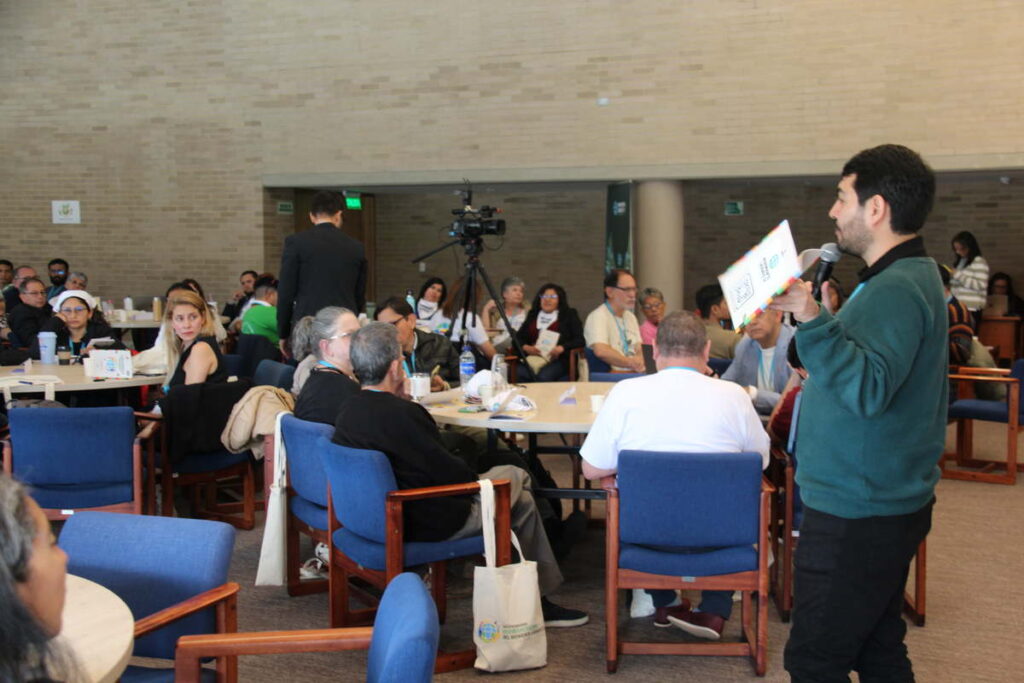
The program continued with “Contemplation with Creation”, a workshop facilitated by Daniel Castellanos Velasco, who leads Laudato Si’ Movement’s eco-spirituality programs.
The invitation to contemplate creation served as a reminder that responding to the socio-environmental crisis does not begin simply by doing more. It also requires us to pause, look, listen, and reconnect with what God has created.
In this way, the day’s various experiences began to form a single path:
contemplating, listening, connecting, discerning, and walking together.
The day continued in the afternoon with the panel “Eco-Spirituality and the Care of Our Common Home”, delving deeper into the perspectives and experiences of people committed to integral ecology.
All of this took place as the Movement prepared to conclude the Season of Creation 2026, celebrated under the theme “Living Water”—an invitation to allow ourselves to be transformed by the water that gives life and to work together for the renewal of creation.
A Regional Manifesto from 19 Countries
The journey that began in Bogotá reached one of its key moments on Sunday, October 4, at 11:00 a.m., with the release of the Regional Manifesto of Laudato Si’ Movement’s First Hispanic-American Encounter.
The document reflects the voices, priorities, and commitments that emerged from the conversations, panel discussions, workshops, moments of prayer, and shared spaces for discernment during the Encounter.
It is one of the concrete outcomes of an Encounter that brought together 110 participants from 19 countries, along with hundreds of people who joined remotely.
The Manifesto seeks to articulate a shared vision of the Laudato Si’ Movement in Hispanic America in the face of the ecological and social challenges facing our peoples and territories, while also pointing out ways to continue strengthening a more synodal approach to the Movement in the region.
The day held special significance as it coincided with the feast of St. Francis of Assisi and the conclusion of the Season of Creation 2026.
At 12:00 p.m., the Sending-Forth Mass marked the spiritual conclusion of the First Hispanic-American Gathering. The participants have been sent back to their countries, communities, and territories to carry with them what they discerned in Bogotá and to continue promoting processes of ecological conversion and action on behalf of our Common Home.
After listening, reflecting, discerning, and walking together, the Gathering thus reached its final moment—not as an ending, but as a sending forth: 19 countries, diverse realities, and a shared mission.
The Encounter ended in Bogotá, but the journey continues in each region. What we have heard, discerned, and sown during these days now returns to the communities to continue making ecological conversion a shared journey.