



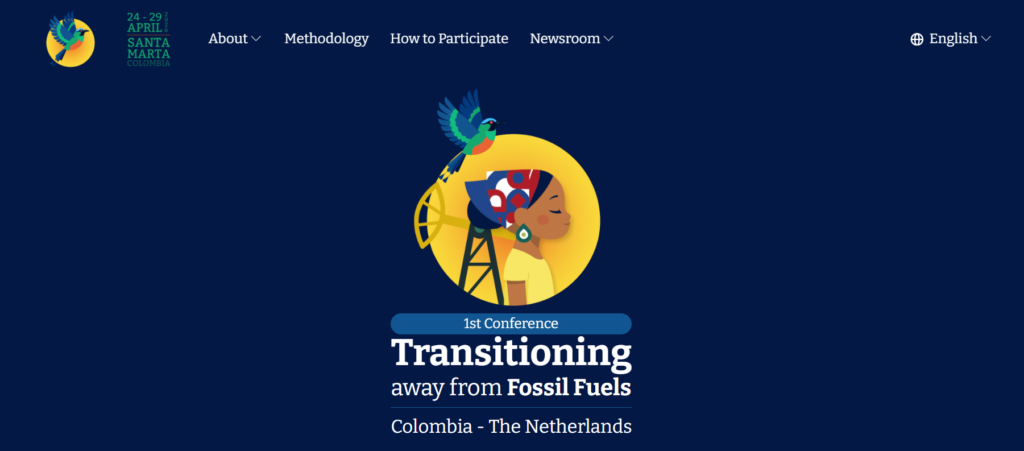
In just a few days, global leaders will gather in Santa Marta, Colombia, for the First Conference on Transitioning Away from Fossil Fuels.
This moment is part of something much bigger: a process to finally build a global framework that can make a fossil fuel phase-out real.
At first glance, it may seem like a small step. But in reality, it is a significant shift because a group of committed leaders are choosing accountability, choosing courage, and choosing to act.
For decades, the world has tried to manage the climate crisis by focusing on pricing and trading emissions—approaches that manage the symptoms while leaving the root cause largely untouched: the ongoing dependence and expansion of coal, oil, and gas.
Now, that must change.
Why This Moment Matters
The climate crisis is no longer a distant threat—it is already devastating lives, especially among those who are least responsible: people living in poverty, Indigenous communities, and vulnerable nations.
This is not only an environmental issue.
It is a moral failure.
As Pope Francis reminds us through Laudato Si’ and Laudate Deum, the cry of the Earth and the cry of the poor are one.
And yet, global systems remain misaligned.
The Paris Agreement has been an essential step in global climate action but it does not address the continued expansion of fossil fuels. As a result, governments can commit to climate goals while still increasing extraction.
This contradiction is no longer acceptable.
It is one of the greatest threats to our common future.
The Road to Santa Marta
For over three decades, global negotiations under the United Nations Framework Convention on Climate Change have been constrained by consensus—often slowed by interests tied to fossil fuels.
Santa Marta opens a new path.
In April 2026, Colombia and the Netherlands are convening a first-of-its-kind conference—designed not to debate the problem, but to advance solutions.
This is more than a meeting.It is the beginning of a sustained political platform for countries ready to move forward with implementation-driven action toward an orderly phase-out of fossil fuels.
And the urgency could not be clearer.
Conflicts in Ukraine, Middle East and the Democratic Republic of Congo highlight how deeply fossil fuels are tied to global instability. These crises do not delay the transition—they make it unavoidable.
Because fossil fuels are embedded in global systems, no country can act alone.
We need coordinated international cooperation, grounded in justice, to ensure the transition is not chaotic—but fast, fair, planned, and inclusive.
Learn more: https://transitionawayconference.com/
From Words to Action
What makes Santa Marta different is its focus on implementation.
This is a space for leaders who are ready to move forward and act.
The vision is clear:
- End new fossil fuel expansion
- Manage a just and orderly phase-out
- Ensure a fair transition for workers and communities
This is the foundation of the Fossil Fuel Treaty.
It is not about replacing existing agreements—but strengthening them. While the Paris Agreement sets targets, recommendations from the Santa Marta conference can provide the binding mechanisms and financial support needed to achieve them.
Why This Matters for the Laudato Si’ Movement
For the Laudato Si’ Movement, this is a deeply aligned and urgent moment.
This process reflects the call to integral ecology—to transform the systems that harm both people and the planet.
It is about:
- Justice for the most vulnerable
- Dignity for workers and communities
- Care for our common home
This is not only a political opportunity.
It is a spiritual and moral responsibility.
We will be present with a small delegation, ensuring that the cry of the Earth and the cry of the poor are heard.
What Can You Do?
This moment belongs to all of us.
Change begins with awareness.
👉 Educate yourself to understand why a Fossil Fuel Treaty is needed
👉 Read the manifesto and explore the vision behind this global effort
👉 Raise your voice to call on leaders to support a just transition
This is our moment to move from awareness to action.
Santa Marta is not just a conference.
It is an opportunity to change the course of our common home.