




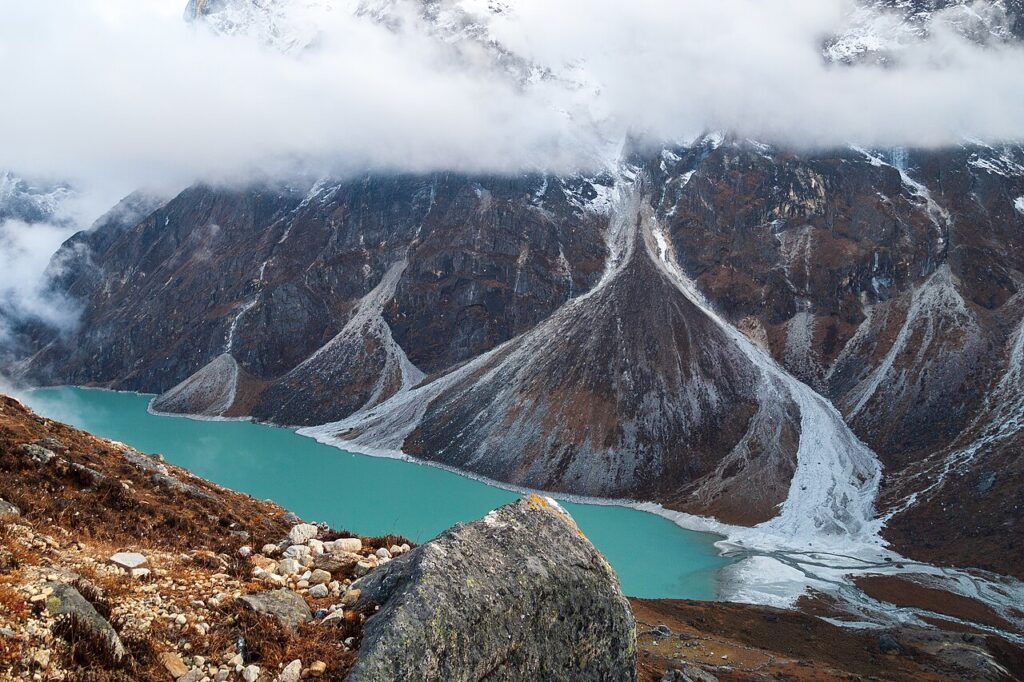
Chola glacial lake in Nepal’s Himalayas, at approximately 4,600 meters above sea level, beneath the Cholatse–Taboche mountain massif. © Vyacheslav Argenberg / Wikimedia Commons
The disaster unfolding in the Himalayas is not only a tragedy. It confronts the world with one of the fundamental injustices of the climate crisis: those who have contributed the least are often among those suffering the most.
For us, this is also a call to listen.
In Laudato Si’, Pope Francis reminds us that we cannot respond adequately to the ecological crisis without hearing “both the cry of the earth and the cry of the poor” (Laudato Si’, 49).
As rescuers continue responding to the devastation caused by the catastrophic floods affecting Nepal and Tibet, we mourn the lives lost, pray for those still missing, and stand in solidarity with families whose homes, livelihoods, and communities have been transformed in a matter of moments.
But alongside our prayers, there is a question the world cannot avoid:
Who is paying the price of the climate crisis—and who bears responsibility for creating it?
Nepal offers a painful answer.
0.1%: a number the world should remember
According to the World Bank Group’s Country Climate and Development Report for Nepal, the country produces approximately 0.1% of total global greenhouse gas emissions.
The World Bank describes Nepal as a “negligible contributor to climate change.”
The latest World Bank data also show that Nepal’s carbon dioxide emissions amount to approximately 0.5 tonnes of CO₂ per person per year.
And yet Nepal stands on one of the frontlines of a rapidly changing climate.
This contradiction goes to the heart of climate injustice:
Nepal has contributed almost nothing to the global climate crisis, yet its people are being asked to live with some of its most dangerous consequences.
A changing Himalaya
Scientists are still investigating the precise chain of events behind this disaster. We must therefore be careful not to claim that climate change alone caused a particular flood, landslide, or glacier collapse.
But the broader direction of change in the Himalayas is increasingly difficult to ignore.
The World Bank warns that rising temperatures, melting glaciers, and more intense rainfall are expected to increase climate-related hazards in Nepal, particularly floods and landslides.
Nepal’s geography makes this especially dangerous.
Communities live beneath glaciers, beside powerful rivers, and along steep mountain valleys. As temperatures rise, glaciers retreat and high-mountain environments change. Water systems become less predictable, while floods, landslides, and glacial lake overflows can threaten communities downstream.
The climate crisis is therefore not a distant projection for Nepal.
It is already becoming part of people’s lived reality.
Those who contributed least are suffering first
This is what climate injustice looks like.
It is a country responsible for only 0.1% of global greenhouse gas emissions being forced to invest precious resources in adapting to a crisis overwhelmingly created beyond its borders.
It is families losing homes and livelihoods to increasingly dangerous climate hazards.
It is farmers facing changing rainfall, flooding, drought, and threats to food security.
It is mountain communities watching the glaciers and water systems that have shaped their landscapes for generations undergo profound transformation.
And the economic consequences could be enormous.
The World Bank estimates that without stronger climate resilience, climate impacts could leave Nepal’s economy at least 7% smaller by 2050 than it otherwise would have been.
Think about what that means.
A country that contributed negligibly to global warming could lose a significant portion of its future economic prosperity responding to its consequences.
The atmosphere does not respect national borders. But responsibility for this crisis is not equally shared.
Prayer must become action
Today, Nepal needs our prayers.
It needs humanitarian assistance.
It needs solidarity with survivors and with those searching for loved ones.
But our solidarity cannot end when this disaster disappears from the headlines.
Climate justice requires the international community—especially countries whose prosperity has been built through decades of high fossil-fuel consumption—to assume greater responsibility.
That means:
- Reducing emissions faster.
The world’s largest historical and current emitters must lead the transition away from fossil fuels. - Financing adaptation.
Countries like Nepal need resources to strengthen infrastructure, protect mountain communities, improve early-warning systems, and prepare for increasingly dangerous climate hazards. - Responding to loss and damage.
When communities suffer destruction from climate impacts they did little to create, international solidarity cannot mean simply offering them more debt. - Protecting the most vulnerable.
Climate policy must begin with the dignity of the people already experiencing the consequences of a warming planet.
And it means recognizing a fundamental principle:
Those who contributed least to the climate crisis should not be left alone to pay its highest price.
From the Himalayas, Living Water carries a message
As Christians enter the Season of Creation 2026, united by the theme “Living Water,” the tragedy in the Himalayas gives these words new urgency.
The glaciers of the Himalayas feed rivers that sustain communities far beyond the mountains. Their waters remind us that we are interconnected—our economies, our emissions, and our responsibility for one another.
Today, we pray for Nepal and Tibet. But prayer must flow into action.
This Season of Creation, let us hear the cry of the Earth and the cry of the poor by reducing our dependence on fossil fuels, advocating for climate finance and loss and damage, and standing with communities on the frontlines of the climate crisis.
Join the Season of Creation. Pray. Act. Raise your voice for climate justice. Let Living Water flow into action.
Because Nepal’s 0.1% of global emissions reminds us of a truth we cannot ignore: those who contributed least to this crisis should not be left to pay its highest price.
Take Action for Creation now!Sources: World Bank Group, Nepal Country Climate and Development Report (2022); World Bank, World Development Indicators, Nepal country data.